Website Migration & Ecommerce Replatforming
Move to a better website platform with confidence
Your website should support your business as it grows. If your current platform is limiting performance, making updates difficult, restricting functionality or creating unnecessary operational costs, it may be time to consider a website migration or ecommerce replatforming project.
Whether you are moving to a new content management system, redesigning an established website, migrating an online store to Shopify or WooCommerce, or upgrading your ecommerce infrastructure, we combine strategic planning, UX design, development and technical SEO to manage the transition.
Website migration services built around your business
Websites CMS Platform Migrations
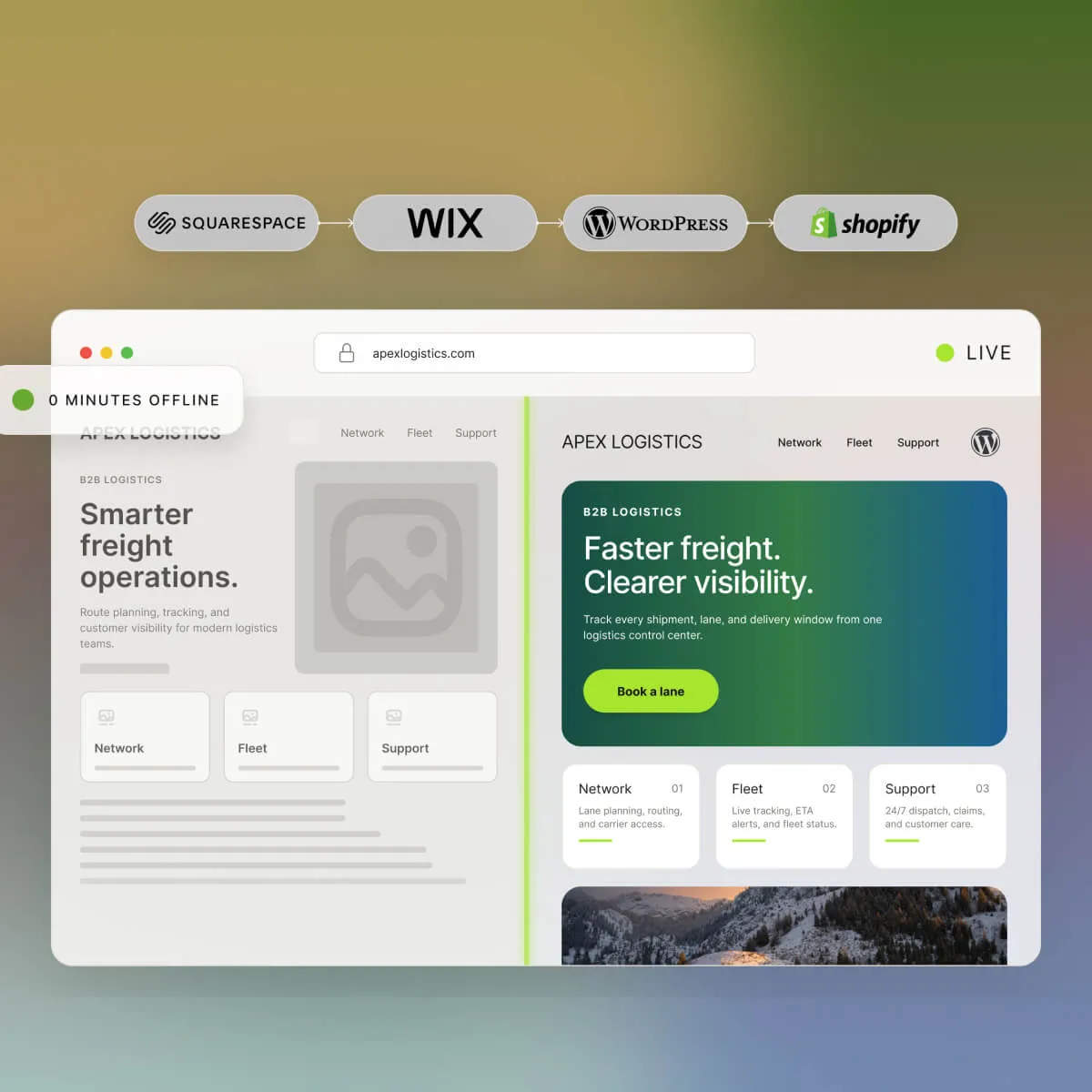
- Website platform migration: Moving an existing website to a more suitable CMS or technology platform.
- Ecommerce platform migration: Moving an online store to Shopify, WooCommerce or Adobe Commerce.
- Website redesign and redevelopment: Combining a platform change with an improved user experience, design system and technical build.
- Ecommerce replatforming: Reassessing your ecommerce platform, store architecture, integrations and operational requirements.
- Website content migration: Planning and transferring existing pages, media, product information and other content.
- Ecommerce data migration: Mapping and transferring relevant product, customer, order and category data, subject to platform capabilities and project scope.
- SEO migration planning: Managing URL mapping, redirects, metadata, canonical URLs, internal links and indexation considerations.
- Integration migration: Planning connections to CRM, ERP, fulfilment, payment, analytics, email marketing and other business systems.
A website migration is more than moving pages from one platform to another. It is an opportunity to improve the user experience, simplify content management, introduce new functionality and create a stronger foundation for future growth.
FDRY helps businesses plan and deliver migrations that consider the full picture: website structure, content, design, functionality, data, integrations, search visibility and ongoing marketing requirements.
Every project starts with understanding your existing website, business objectives and technical requirements. This allows us to recommend a migration approach that is appropriate for your business rather than simply moving your existing problems to a new platform.
For ecommerce businesses, changing platforms can affect much more than the appearance of an online store. Your product catalogue, customer accounts, checkout, payments, fulfilment, stock management, marketing integrations and reporting all need to be considered.
FDRY helps ecommerce businesses plan and deliver platform migrations with a focus on usability, functionality, maintainability and commercial performance.
Wix website migration
Wix can be a practical starting point for a business website, but growing organisations may eventually need different design flexibility, content management capabilities, integrations or ecommerce functionality.
FDRY can help plan a migration from Wix to WordPress, Webflow or another suitable platform. Depending on the destination, this may involve rebuilding page templates, transferring content and media, restructuring navigation, mapping URLs and reviewing existing search visibility.
The aim is to create a website that meets your current requirements while providing a more suitable foundation for future development.
Webflow migration and replatforming
Businesses using Webflow may consider a migration when their content management, integration, ecommerce or development requirements change.
FDRY can assess migrations from Webflow to WordPress or another suitable platform, as well as projects that combine a replatforming exercise with a redesign.
The work may include content and media migration, CMS collection mapping, template redevelopment, URL redirects, metadata reviews and the recreation of important website functionality. We assess the existing site and destination platform to establish what can be transferred directly and what needs to be rebuilt.
WordPress migration and replatforming
WordPress supports a wide range of business websites, but a site’s requirements can change as its content, functionality, traffic or commercial model develops.
FDRY can help businesses migrate an existing WordPress website to a different CMS, or replatform a WordPress-powered website as part of a wider redesign or redevelopment project.
Depending on the requirements, this may involve moving to Webflow, another CMS or a more suitable ecommerce platform. We can assess existing themes, plugins, custom functionality, content, media, forms, integrations and URL structures before defining the migration scope.
Where WooCommerce is involved, we also consider the product catalogue, customer and order data, checkout requirements and other ecommerce-specific dependencies.
Ecommerce migrations agency
Migrating your ecommerce store for growth
Shopify Migration
Shopify can provide a flexible foundation for businesses looking to simplify ecommerce management and develop their online sales channels.
FDRY can help plan and deliver migrations to Shopify, including store design, theme development, product and content migration, integrations, tracking and technical SEO considerations.
We can also assess whether Shopify Advanced or Shopify Plus is appropriate for your business requirements.
WooCommerce migration
WooCommerce can suit businesses that want the flexibility of WordPress alongside a configurable ecommerce platform.
We can help businesses move to WooCommerce, rebuild an existing WooCommerce store or restructure a store that has become difficult to manage. Our work can include WordPress development, product and content migration, plugin assessment, integrations and SEO migration planning.
Adobe Commerce and Magento migration
Businesses with more complex ecommerce operations may need to assess Adobe Commerce, Magento or an alternative platform as part of a wider replatforming strategy.
FDRY can help evaluate platform requirements, user journeys, integrations, catalogue complexity and ongoing management needs before defining an appropriate design and development approach.
BigCommerce migration
If your existing BigCommerce store no longer meets your requirements, migrating to another ecommerce platform may offer greater flexibility over your storefront, integrations or ongoing management.
FDRY can help plan a BigCommerce migration to platforms such as Shopify, WooCommerce or Adobe Commerce, depending on your business needs. The project may include product catalogue migration, category mapping, customer and order data assessment, URL redirects, storefront redevelopment and integration planning.
Our approach considers the wider ecommerce operation, helping you identify what needs to be transferred, improved or reconfigured before launch.
Salesforce Commerce Cloud migration
Salesforce Commerce Cloud can support complex ecommerce operations, but businesses may reassess their platform as their commercial priorities, technical requirements or operating costs change.
FDRY can help assess a move from Salesforce Commerce Cloud to an alternative ecommerce platform, including Shopify, WooCommerce or Adobe Commerce where appropriate.
Migration planning can cover catalogue structures, product data, customer records, order history, integrations, content, URL mapping and SEO considerations. The scope will depend on your existing Salesforce implementation, connected systems and the capabilities of the destination platform.
For complex enterprise environments, we establish the technical requirements and dependencies before recommending a migration approach.
Moving between ecommerce platforms
The right destination depends on your business model, operational requirements, catalogue, integrations, budget and plans for growth.
Depending on the existing technology and project scope, migration projects may involve transitions such as:
- WooCommerce to Shopify
- BigCommerce to Shopify
- Salesforce to Adobe Commerce
- Magento to Adobe Commerce
- Magento or Adobe Commerce to Shopify
- Shopify to Shopify Plus
- Another ecommerce platform to WooCommerce or Shopify
We assess each migration individually rather than assuming that one platform is right for every business.
Deciding on the best platform
Choosing the right migration destination
The best platform depends on more than the technology you currently use. We consider your business objectives, content requirements, ecommerce operations, integrations, budget and plans for growth before recommending a direction.
Our goal is to help you make an informed platform decision and plan a migration that accounts for design, functionality, data, technical SEO and ongoing website management.
When should you consider a website migration?
A migration may be worth considering when your current website is creating problems for your team or holding back your commercial plans.
Your current platform is limiting growth
You may be struggling to introduce new functionality, improve customer journeys or support changing business requirements. A more suitable platform can provide a stronger foundation for future development.
Your website is difficult to manage
If routine updates require excessive development time, content management is cumbersome or the site relies on a fragile collection of plugins and workarounds, a migration may simplify ongoing operations.
Your ecommerce store needs better functionality
Your online store may need improved product management, more flexible promotions, better checkout journeys, new payment options or integrations with other business systems.
Your website needs a redesign
A platform migration can be an opportunity to improve navigation, page layouts, mobile usability, accessibility and the overall customer experience.
Your technical infrastructure needs attention
An ageing or poorly maintained website can create challenges around security, compatibility, performance and future development. The right approach may be a migration, a targeted rebuild or improvements to the existing platform.
Your business is changing
A merger, acquisition, new business model, international expansion or change in marketing strategy may create requirements that your existing website cannot easily support.
Before recommending a migration, we assess whether moving platforms is genuinely necessary. In some cases, improving the existing website may be the more practical and cost-effective option.
SEO migrations
Protecting your SEO during a website migration
Your website may have built up valuable search visibility over many years. A migration needs to account for that value, particularly when changing URLs, page structures, content or the underlying platform.
FDRY incorporates technical SEO considerations into the migration process to help reduce avoidable disruption. Our process checks the following during any migration or replatforming activity:
- Reviewing existing organic landing pages and search performance data.
- Crawling the existing website and identifying important URLs.
- Mapping old URLs to the most relevant new destinations.
- Implementing and testing appropriate permanent redirects.
- Reviewing title tags, meta descriptions, headings and important page content.
- Checking canonical URLs, robots directives and XML sitemaps.
- Reviewing internal links and identifying broken links or redirect chains.
- Checking structured data where relevant.
- Testing crawlability and indexation settings before and after launch.
- Monitoring organic traffic, indexed pages and technical issues following release.
The objective is to retain valuable content and search signals where appropriate while improving the website’s structure and technical foundations.
Search performance can fluctuate following a migration, and results depend on many factors beyond the migration itself. Careful preparation and monitoring help identify problems, but no agency can guarantee that all existing rankings will remain unchanged.
Web content, structure and databases
Content and data migration
Moving a website involves more than copying visible page content. Different platforms organise information in different ways, so the migration needs to account for how content and data are structured in the existing and destination systems.
Depending on your website, the migration scope may include:
- Website pages and landing pages.
- Blog posts, articles and other editorial content.
- Images, documents and downloadable resources.
- Product information, categories and variants.
- Customer records and order history, where supported and appropriate.
- Product images, attributes and associated metadata.
- Navigation, internal links and page relationships.
- Forms and relevant integrations.
- SEO metadata and URL mappings.
We identify what needs to be migrated, what should be improved or removed, and how the information should be mapped to the new platform.
Data migration requirements vary by platform. Certain customer passwords, transaction details, app-specific data or historical records may not transfer directly and can require alternative approaches. These limitations are identified during discovery and planning.
All customer and business data must be handled in accordance with applicable privacy, security and data protection requirements.
Our website migration and replatform process
FDRY 7 step process
A successful migration starts with a clear plan. FDRY works through a structured process to understand the existing website, define the target solution and manage the work required for launch.
1. Discovery and website audit
We review your existing website, platform, content, functionality and integrations. For ecommerce projects, this can include the product catalogue, customer and order data requirements, checkout journey and operational workflows.
We also identify existing SEO assets, important landing pages, URL structures and known technical issues.
2. Platform strategy and planning
We assess your requirements against suitable platform options, considering functionality, flexibility, ongoing management, integrations, cost and future development.
The outcome is a defined scope and migration plan, including key dependencies, responsibilities, risks and priorities.
3. UX design and website structure
Where required, we develop improved user journeys, navigation, page templates and visual design. This is an opportunity to address usability issues and create a more effective experience for customers and internal teams.
4. Development and integration
We build or configure the destination website, implement agreed functionality and connect the relevant business systems.
The technical approach depends on the platforms involved, the available data, integration requirements and the agreed project scope.
5. Content, data and SEO migration
We plan the transfer of relevant content and data, map old URLs to their appropriate destinations and prepare redirects where required.
We also review important metadata, internal links, canonical URLs, XML sitemaps and indexation settings. Where relevant, we retain or improve existing content rather than removing valuable search assets without a clear reason.
6. Testing and quality assurance
Before launch, we test the website against the agreed requirements. Depending on the project, this can include mobile layouts, forms, navigation, product pages, checkout, payments, integrations, analytics, redirects and key customer journeys.
We also check for broken links, missing content, unexpected indexing directives and other issues that could affect the launch.
7. Launch and post-launch monitoring
We coordinate the launch plan, carry out agreed technical checks and monitor the website after release.
Post-launch checks can include redirect responses, crawlability, indexation signals, analytics tracking, conversion journeys and any issues identified during live testing.
A migration cannot guarantee unchanged search rankings or uninterrupted operation in every circumstance. Our approach is designed to identify risks, prepare for them and resolve issues promptly.
Website migration for long-term growth
- User experience: Improve navigation, page layouts, product discovery, forms and conversion journeys.
- Website management: Make it easier for your team to maintain content, update products and manage everyday changes.
- Technical foundations: Review site architecture, maintainability, integrations and performance-related issues.
- Digital marketing: Ensure the new website supports your SEO, analytics, email marketing, paid media and content requirements.
- Future development: Create a platform and website structure that can accommodate changing business needs.
A migration should deliver more than a new technical platform. It should help your business operate more effectively and give customers a better experience.
We consider the migration alongside your wider website and digital marketing objectives, helping you make informed decisions about what to retain, improve or replace.
FDRY combines website design, development and digital marketing expertise to help businesses plan and deliver website and ecommerce platform changes. Our approach brings together:
- Strategic planning: We start with your business requirements and platform needs.
- Website design and UX: We consider the customer experience alongside the technical migration.
- Ecommerce expertise: We work with platforms including Shopify, WooCommerce and Adobe Commerce.
- Technical development: We plan the functionality, integrations and implementation required for the destination website.
- SEO awareness: We consider URL mapping, redirects, metadata and indexation as part of the migration.
- Digital marketing alignment: We take account of the tracking, content and marketing systems needed after launch.
- Ongoing support: We can discuss further development and optimisation once the migrated website is live.
Our recommendations are based on the needs of the individual project, with a focus on creating a website that is fit for purpose and easier to develop over time.
FAQs Migrations and Replatfroming
Frequently asked questions
What is a website migration?
A website migration is a significant change to a website’s platform, technology, structure, URLs or domain. It may involve moving to a new CMS, rebuilding a website, changing hosting arrangements or combining a redesign with a new technical platform.
The scope depends on the type of migration and the requirements of the business.
What is ecommerce replatforming?
Ecommerce replatforming is the process of moving an online store from one ecommerce platform to another. It can involve migrating products, categories, customer and order data, rebuilding the storefront, reconnecting integrations and testing the buying journey.
The aim is to move to a platform that better supports the business’s operational and commercial needs.
Can you migrate a website from any platform?
FDRY can assess migrations involving platforms such as Shopify, WooCommerce, Adobe Commerce, BigCommerce, Salesforce Commerce Cloud, Wix, Webflow and WordPress. The feasibility, cost and complexity depend on the existing website, destination platform, data requirements and integrations. We review these factors before confirming the project scope.
How much does a website migration cost?
The cost depends on the size and complexity of the existing website, the destination platform, the amount of content or data involved, design requirements, integrations and the amount of custom development needed.
A straightforward website migration will usually require a different level of investment from a complex ecommerce replatforming project. FDRY can scope the work following an initial discussion and review of your requirements.
How long does a website migration take?
Timescales depend on the project scope, platform, data complexity, design and development requirements, integrations and availability of client-side resources.
A smaller website migration may be relatively straightforward, while a large ecommerce replatforming project may require several phases of discovery, design, development, testing and launch preparation. We establish a realistic schedule during project planning.
Can you migrate a website without losing SEO rankings?
No agency can guarantee that rankings will remain unchanged after a migration. However, careful SEO planning can reduce avoidable risks.
This includes reviewing existing search performance, mapping URLs, implementing appropriate redirects, retaining valuable content and metadata, testing indexation settings and monitoring performance after launch.
Will my website need a redesign during migration?
Not necessarily. A migration can retain much of the existing design, or it can be combined with a redesign to improve usability, brand presentation and conversion journeys.
We assess whether a redesign is beneficial based on your objectives, the capabilities of the destination platform and the condition of your current website.
Can you migrate an online store to Shopify or WooCommerce?
Yes. FDRY can assess migrations to Shopify and WooCommerce, as well as projects involving Adobe Commerce. The appropriate solution depends on your catalogue, integrations, customer experience requirements, operational processes and future plans.
Can you migrate customer and order data?
Potentially, depending on the source and destination platforms, data structure, permissions and technical limitations. We define the required data, assess what can be transferred and identify any information that needs an alternative migration or retention approach.
Do you provide SEO migration services separately?
SEO migration can be scoped as part of a wider website or ecommerce migration, or discussed as a separate requirement. The work can include URL mapping, redirects, technical checks, metadata review and post-launch monitoring.
What happens after the website launches?
Post-launch support can include technical checks, redirect validation, crawlability and indexation monitoring, analytics verification and resolution of issues identified after release. The exact support arrangements are agreed as part of the project.
Planning a website migration?
Whether you are moving to a new CMS, rebuilding an existing website or replatforming an ecommerce store, FDRY can help you assess the options and define a practical route forward.
Tell us about your current website, the platform you are considering and what you want to achieve. We can discuss the requirements, identify the key migration considerations and establish the next steps.
Ready to discuss your website migration or ecommerce replatforming project?