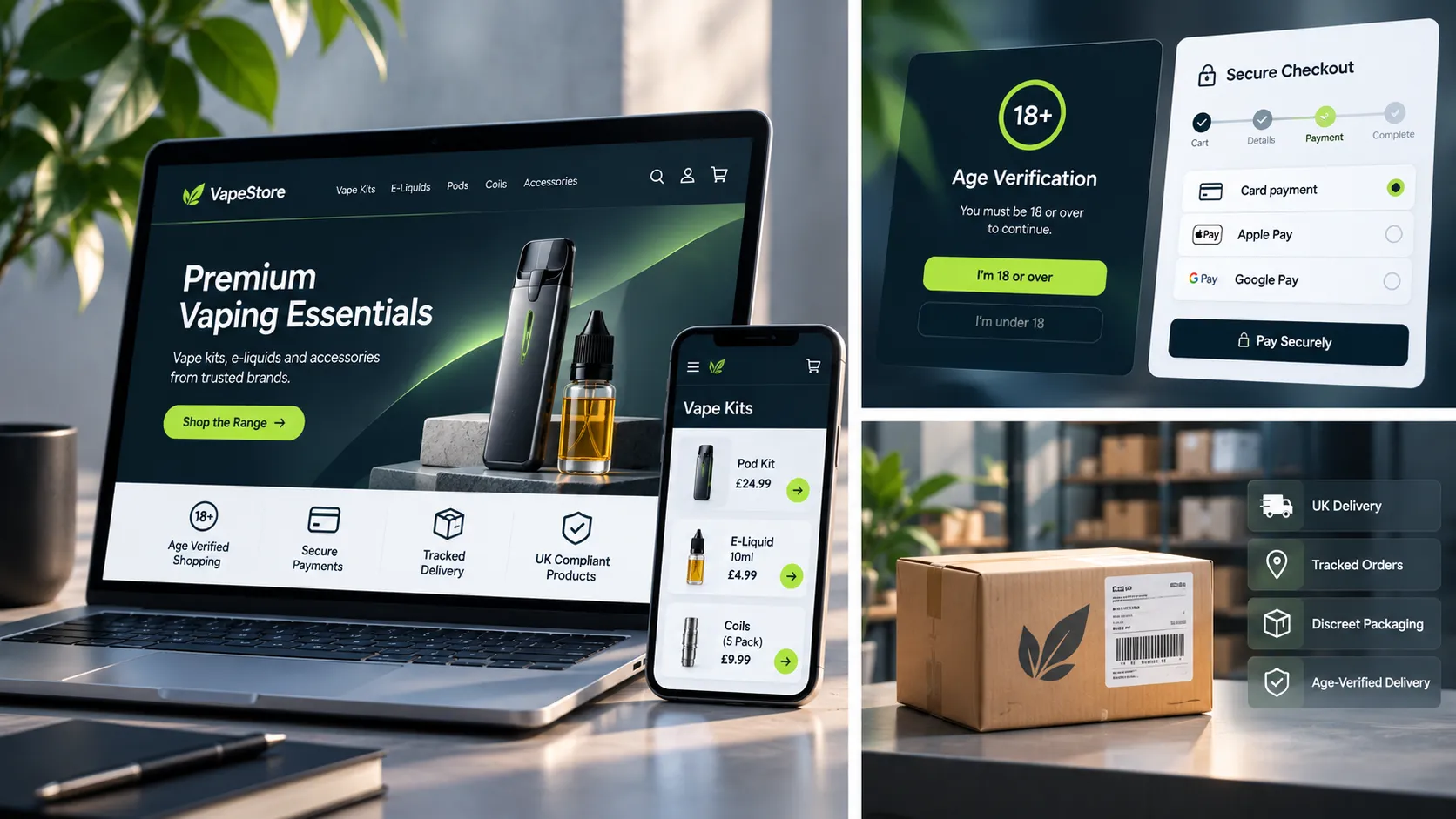
Setting up an online vape shop involves considerably more than choosing an ecommerce platform, uploading products and switching on card payments.
The UK vaping industry operates in a highly regulated environment. Businesses planning to sell online must consider several important factors before investing in a new website. These include selecting the right ecommerce platform, securing a payment provider that supports vape retailers, integrating effective age verification and choosing delivery partners that can handle their products.
Businesses must also understand product compliance, online advertising restrictions, customer data requirements and how they present products across their websites.
For businesses entering the market, getting these decisions right from the beginning can prevent expensive changes later. For established vape retailers, a website redevelopment or ecommerce migration is an opportunity to improve the customer experience while addressing technical and operational limitations.
At FDRY, we work with businesses to design and develop ecommerce websites around their products, customers and operational requirements. In this guide, we explore the key considerations when planning a vape ecommerce website in the UK.
Why vape website design requires a different approach
Most ecommerce websites follow a familiar process: customers browse products, add items to their basket, complete checkout and receive their order.
A vape ecommerce website needs to support that same journey, but with additional considerations built into the architecture.
For example:
- Customers must meet the legal age requirements before purchasing regulated products.
- Payment providers must be willing to process transactions for the vaping industry.
- Delivery companies must accept the specific products being shipped.
- Product listings need to reflect the relevant UK product regulations.
- The website must be designed around restrictions on advertising and promotion.
- Stock, orders and customer information may need to connect with other business systems.
These requirements influence decisions about the website platform, checkout, integrations and ongoing management.
This is why we recommend treating a vape website project as an ecommerce and operational planning exercise, not simply a website design project.
Understanding UK vaping regulations before building your website
Before developing an online vape shop, it is important to understand the regulations that apply to the products you intend to sell.
The regulatory framework includes the Tobacco and Related Products Regulations 2016 (TRPR), the Tobacco and Vapes Act 2026 and guidance from organisations including the Medicines and Healthcare products Regulatory Agency (MHRA) and the Department of Health and Social Care.
Some of the key considerations include:
Age restrictions
Since 29 October 2026, the minimum age of sale for vaping and nicotine products across the UK is 18. This applies to online retailers as well as physical shops. It is also an offence for an adult to purchase these products on behalf of someone under 18.
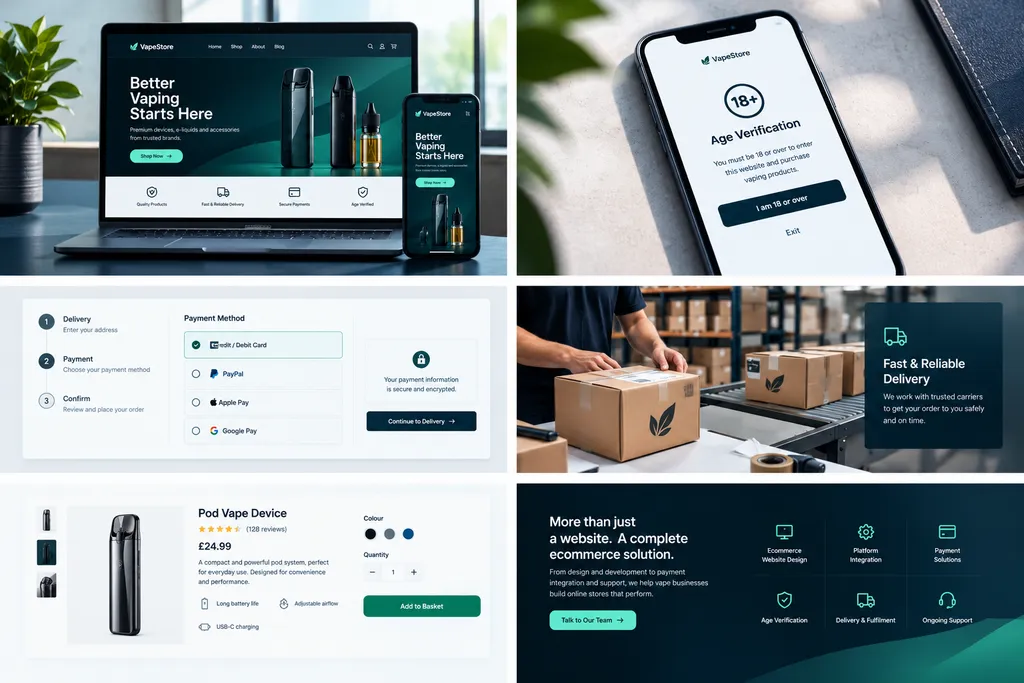
An online retailer therefore needs a suitable process to establish that customers are old enough to purchase the products. A simple pop-up asking visitors to confirm that they are over 18 should not be treated as a complete age-verification solution.
Product restrictions
For nicotine-containing e-cigarettes and refill containers, the established TRPR requirements include:
- A maximum nicotine strength of 20mg/ml.
- A maximum capacity of 2ml for e-cigarette tanks.
- A maximum volume of 10ml for nicotine-containing refill containers.
- Appropriate child-resistant and tamper-evident packaging.
- Required product labelling and health warnings.
- Product notification and publication through the relevant MHRA process before products can be sold.
The retailer should ensure that the products listed on the website are compliant and that suppliers can provide the necessary information.
Single-use vape ban
Since 1 June 2025, UK law has banned businesses from selling or supplying single-use vapes, whether they contain nicotine or not. The ban covers online retailers as well as physical shops.
Vape retailers must regularly review their ecommerce catalogues and remove any products that fall under this ban, ensuring customers cannot purchase them through their websites.
Vaping Products Duty and duty stamps
There are further changes affecting vape retailers in 2026 and 2027. Vaping Products Duty applies to vaping liquid, including liquid without nicotine, at a flat rate of £2.20 per 10ml. The duty stamp scheme also affects products entering the UK market.
From 1 October 2026, liable products released onto the UK market must carry the required duty stamp. A transitional period allows certain existing unstamped stock to be sold until 31 March 2027. From 1 April 2027, all vaping products outside duty suspension must have the required stamp.
Retailers should understand how these requirements affect their stock, suppliers and product records.
Why this matters for your website
The website should not be responsible for deciding whether a product is legally compliant. That responsibility sits with the business. However, the ecommerce system should make it easier to manage accurate product information, remove products that can no longer be sold and maintain a clear record of what is available for purchase.
It is worth establishing these requirements before the design and development process begins.
Choosing the right ecommerce platform for a vape shop
One of the first questions businesses ask is which ecommerce platform is best for selling vape products.
There is no universal answer. The right choice depends on the size of the business, its product range, the integrations it requires and, importantly, whether the platform and its associated services will support the business model.
A platform may provide all the technical features needed to operate an online shop, but that does not automatically mean its payment services, sales channels or other connected products will accept vape retailers.
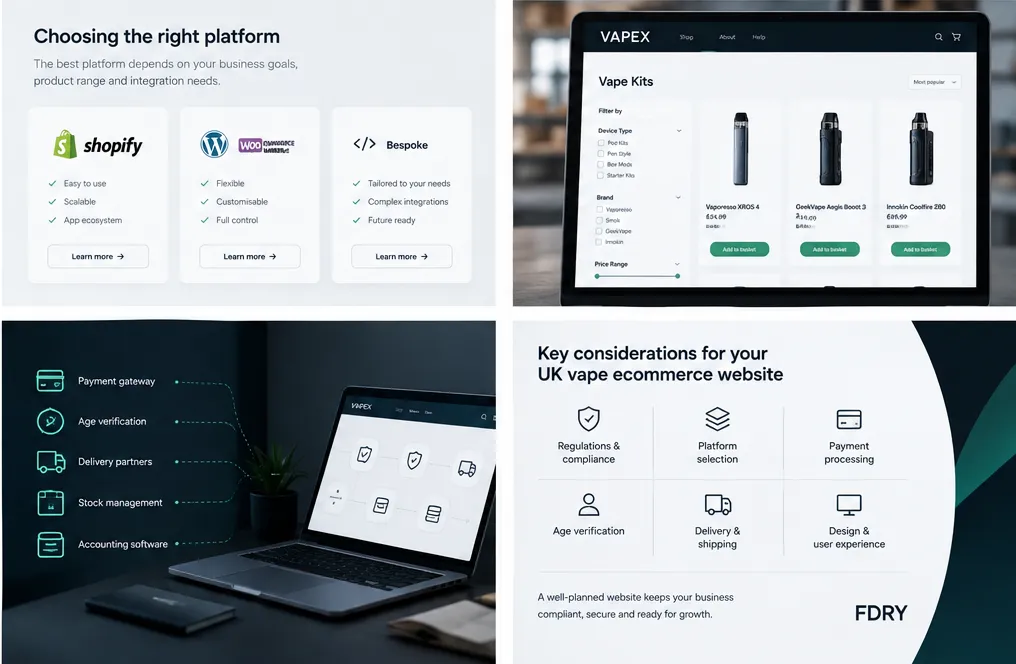
Here are some of the options worth considering.
WooCommerce
WooCommerce is an ecommerce platform built around WordPress. It offers flexibility over the design, functionality and hosting environment of an online shop.
For vape retailers, this can be particularly useful where the business needs:
- Greater control over the website and its hosting.
- A tailored product catalogue and product filtering.
- Integration with a specialist payment gateway.
- Custom age-verification functionality.
- Connections to stock management, accounting and fulfilment systems.
- More control over the customer journey and checkout experience.
WooCommerce does not itself guarantee that a vape retailer can accept payments. The chosen payment provider, acquiring bank, hosting company and other service partners may each have their own restrictions.
However, its flexibility can make it a suitable option for businesses that need a tailored ecommerce solution.
Shopify
Shopify is a popular hosted ecommerce platform, known for its ease of use and managed infrastructure.
However, vape retailers need to approach Shopify with particular care. Shopify’s platform policies, Shopify Payments terms and the eligibility of its additional sales channels are separate considerations.
Shopify’s published guidance explains that regulated products are subject to applicable laws and its own terms. Its payment service also has restrictions on regulated product categories. In 2026, Shopify’s position on electronic nicotine delivery products has become an especially important issue for merchants.
Do not assume that because you can create a Shopify store, you will be permitted to sell vape products through it. Before choosing Shopify, obtain written confirmation that your intended products and business model are acceptable under the current terms, including any restrictions on payment processing and store operation.
Bespoke ecommerce development
Some businesses have more complex requirements, particularly established retailers with multiple branches, wholesale operations, large product catalogues or existing stock management systems.
In these situations, a bespoke ecommerce solution or a more tailored implementation of an established platform may be worth considering.
This approach can provide greater control over integrations, product management and the checkout journey. However, it also needs careful planning around maintenance, security, hosting, costs and future development.
Which platform should you choose?
For many businesses, WooCommerce is worth investigating because of its flexibility and ability to work with third-party payment providers.
However, platform selection should follow payment and operational feasibility checks, not precede them. There is little value in investing in a website only to discover that the payment provider or hosting arrangement will not support the business.
Payment gateways: one of the biggest challenges for vape retailers
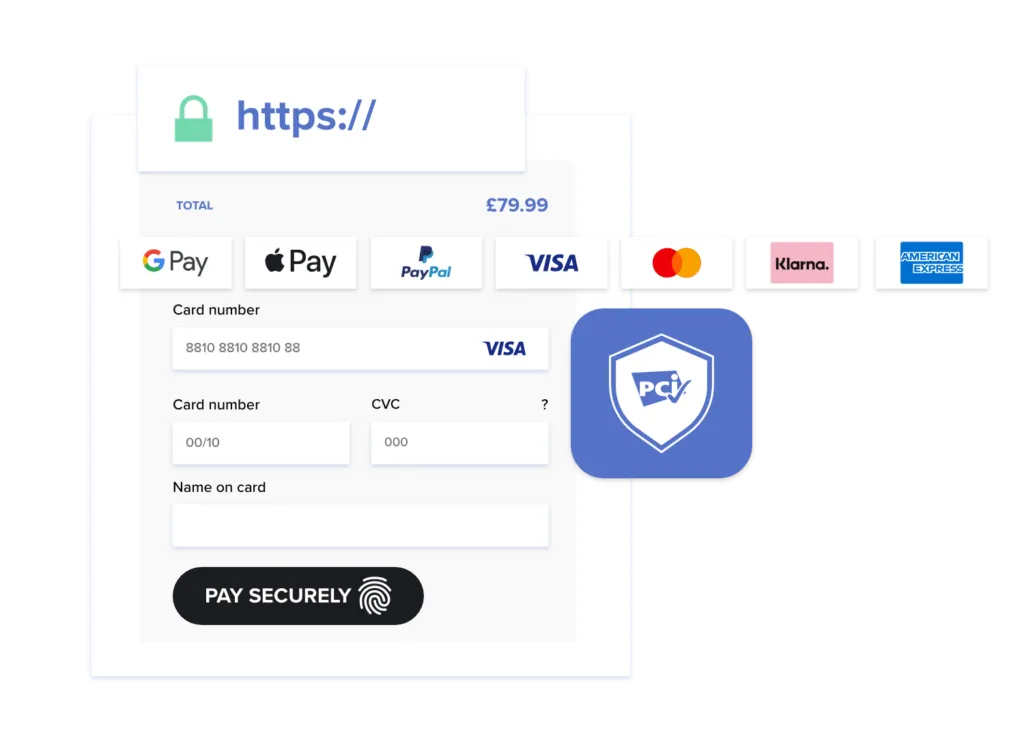
Payment processing is often one of the most difficult parts of launching a vape ecommerce website.
Many mainstream payment providers classify vaping and electronic cigarette products as restricted or higher-risk business categories. Their policies can vary, and approval may depend on the exact products being sold, the business model, location and compliance arrangements.
This means that a standard payment integration cannot simply be assumed to work.
Can a vape shop use Stripe?
Businesses should not assume that Stripe will support a vape ecommerce operation. Its restricted-business rules need to be reviewed against the precise products and services being offered.
The same principle applies to other mainstream payment services. A provider’s general availability in the UK does not mean it accepts every industry.
What is a specialist vape merchant account?
A specialist merchant account is a payment facility arranged with a provider or acquiring bank that is prepared to underwrite the particular risks associated with the business.
The setup may involve three connected elements:
- Merchant account: The facility that allows the business to accept card payments.
- Payment gateway: The technology that securely sends payment information between the website and payment processor.
- Acquiring bank or payment processor: The organisation responsible for processing transactions and settling funds.
The provider will normally assess the business before approving an account. This may include reviewing the website, product range, company information, expected turnover, fulfilment arrangements and compliance processes.
What should you ask a payment provider?
Before committing to a website platform or development project, speak to potential payment providers and ask:
- Do you explicitly support UK vape and e-cigarette retailers?
- Which products are permitted and are any categories excluded?
- Can your gateway integrate with WooCommerce or the chosen ecommerce platform?
- Do you support recurring payments, if required and permitted?
- What are the transaction fees and monthly costs?
- Are there rolling reserves or delayed settlement periods?
- What are the chargeback and dispute requirements?
- What age-verification or compliance measures do you expect?
- What happens if the product range or business model changes?
It is important to disclose the full product range from the beginning. Applying under a generic retail category and introducing vape products later can lead to account reviews, payment disruption or termination.
Our recommendation: establish payment-provider suitability before choosing the ecommerce platform. The website should be built around a payment solution that has been approved for the business, rather than assuming a payment service can be added at the end.
Age verification: building responsible purchasing into the customer journey
Age verification is an essential consideration for any online retailer selling age-restricted vaping or nicotine products.
A visitor simply confirming that they are over 18 through a website pop-up does not, on its own, establish their age.
Retailers need to be satisfied that customers are at least 18 before making a sale. The appropriate process should be considered as part of the website architecture.
There are specialist age-assurance services that can help businesses verify customers using methods such as identity checks, database verification and other forms of age estimation or assurance.
The right solution will depend on the business, its customers, its chosen payment provider and the relevant legal requirements.
Where should age verification happen?
Retailers can introduce age verification at several stages of the customer journey:
- Website entry: An initial age-screening step tells visitors that the store sells age-restricted products. However, retailers should not rely on this step as their only age check.
- Account registration: Retailers can verify a customer’s age when they create an account.
- Checkout: The website can trigger an age-verification check before allowing customers to complete an order.
- Delivery: Depending on the fulfilment arrangement, retailers may also need to use an age-verification service when the courier delivers the order.
Retailers should choose the right combination of checks based on their legal obligations and risk assessment.
Integrating age verification into ecommerce
From a development perspective, age verification must work seamlessly with the rest of the website and checkout process.
For example, the system should prevent customers from placing an order until they complete the required age checks. It should also explain each step clearly and guide customers through failed or inconclusive verification attempts.
Privacy is equally important. Age-assurance providers may process personal information, so retailers should check what data each service collects, why it needs that information, how long it keeps the data and who controls its processing.
Delivery and shipping: finding a courier that accepts vape products
Delivery is another area that can cause problems for vape retailers.
Not every courier accepts nicotine-containing liquids, electronic cigarette devices or products containing lithium batteries. Some carriers prohibit certain products altogether, while others may accept them subject to specific conditions.
For example, published UK carrier restrictions include exclusions for nicotine-containing e-cigarette liquids. Royal Mail’s published prohibited and restricted items information also sets out conditions for sending e-cigarettes and lithium batteries.
The important point is that you should never assume a courier will accept your products simply because it offers a standard ecommerce parcel service.
What should you check with delivery providers?
Before selecting a courier, provide a detailed description of the products you intend to ship and ask for written confirmation.
Consider the following:
- Does the courier accept nicotine-containing e-liquids?
- Can it carry vape devices containing lithium batteries?
- Are there restrictions on battery type, quantity or packaging?
- Are there limits on liquid volume or concentration?
- Are there special packaging and labelling requirements?
- Can the courier provide an age-verified delivery service?
- Are there restrictions on international shipments?
- Does the service cover all the locations you intend to sell to?
Do not rely on general sales information or assumptions. Ask the carrier to confirm the exact product categories and shipping arrangements in writing.
Integrating delivery services with your website
Once a suitable delivery provider has been identified, the next step is to consider how it will connect to the ecommerce platform.
A well-integrated delivery process can help automate:
- Shipping cost calculations.
- Delivery options at checkout.
- Order and fulfilment notifications.
- Shipping label generation.
- Tracking information.
- Dispatch updates.
- Returns management.
For businesses processing a high volume of orders, these integrations can save considerable administrative time.
It is also worth considering how the website handles products that have different shipping requirements. For example, certain devices, batteries and liquids may need different fulfilment rules.
Designing a vape ecommerce website around the customer
Once the operational requirements have been established, the focus can turn to the website itself.
A successful vape ecommerce website should make it easy for customers to understand the product range, find relevant information and complete their purchase.
However, the design should also reflect the restrictions that apply to the vaping industry. Marketing and promotional content must be reviewed carefully rather than simply following conventional ecommerce practices.
Clear product categorisation
A well-organised product catalogue makes a significant difference to the shopping experience.
Depending on the products being sold, categories might include:
- Refillable vape devices.
- Vape kits.
- E-liquids.
- Replacement pods.
- Coils.
- Accessories.
- Charging equipment.
The exact structure will depend on the retailer’s product range.
Product filters can also help customers narrow down their choices. These might include device compatibility, product type, capacity or other factual product specifications.
Detailed product information
Product pages should provide accurate and useful information about each item.
This could include:
- Product name and manufacturer.
- Product type and specifications.
- Compatible devices or components.
- Bottle size or capacity, where applicable.
- Nicotine strength, where applicable.
- Required product warnings and labelling information.
- Manufacturer information.
- Clear availability and delivery information.
Product information should be accurate, consistent with the physical packaging and compliant with the relevant regulations.
Mobile-first ecommerce design
A large proportion of ecommerce browsing takes place on mobile devices, so the website should be designed to work particularly well on smaller screens.
This means considering:
- Easy-to-use navigation.
- Clear product information.
- Readable specifications.
- Fast-loading product images.
- An accessible basket and checkout.
- Straightforward age-verification steps.
A good mobile experience should make the website easy to use without removing important compliance or product information.
A straightforward checkout
Design the checkout around the approved payment provider and the retailer’s age-verification process.
Customers should know which information they need to provide, what verification they must complete and which delivery options they can choose. Keep the process simple by removing unnecessary steps, but never compromise essential checks just to reduce checkout friction.
Marketing and SEO for a UK vape website
Search engine optimisation can help businesses make their websites easier to discover through relevant search queries. However, vape retailers need to be particularly careful about the distinction between search optimisation, factual website information and prohibited advertising or promotion.
The UK has specific restrictions on the advertising and promotion of electronic cigarettes and related products. Online marketing is not simply a case of applying the same tactics used by an ordinary ecommerce retailer.
Before publishing promotional content or running a campaign, businesses should obtain advice on the applicable advertising rules and the CAP Code.
From a website and technical SEO perspective, there are still important foundations to consider:
- Clear website navigation and information architecture.
- Search-engine-friendly page structure.
- Descriptive page titles and headings.
- Accurate product information.
- Fast page loading and mobile usability.
- Accessible website content.
- Structured product data where appropriate and permitted.
- Secure hosting and technical maintenance.
It is important to distinguish technical SEO from promotional activity. Optimising the structure and accessibility of a website does not automatically make every product-related page or marketing message permissible.
Businesses should also check whether the relevant rules permit paid search, social media advertising, influencer marketing, email promotions and discount campaigns. They must assess each marketing channel and activity against the applicable regulations before proceeding.
Other ecommerce integrations to consider
A vape ecommerce website may need to connect with several systems beyond the website and payment gateway.
The right integrations will depend on the size and complexity of the business.
Stock management
If products are sold through both physical stores and an online shop, stock levels need to remain synchronised. This helps prevent overselling and reduces manual administration.
Accounting software
Connecting the website to accounting software can simplify order reconciliation, sales reporting and financial administration.
Order management and fulfilment
Businesses with a high volume of orders may benefit from an order management system that connects the website, warehouse and delivery provider.
Customer service
Customer support tools can help manage order enquiries, delivery issues and product questions. Any customer communication or marketing functionality must be configured in line with the relevant privacy and promotional rules.
Reporting and analytics
Accurate reporting helps business owners understand website performance, order volumes, revenue, operational costs and customer behaviour.
The objective is to create a connected ecommerce operation rather than a website that requires every task to be managed manually.

What does it cost to build a vape ecommerce website?
The cost of developing a vape ecommerce website depends on the scale of the project and the complexity of the required functionality.
A relatively straightforward online shop with a carefully structured product catalogue will have different requirements from an established retailer with multiple branches, thousands of products, specialist payment processing and complex fulfilment integrations.
Some of the main factors affecting the budget include:
- Website design and user experience.
- Ecommerce platform and hosting.
- Product catalogue size and data migration.
- Payment gateway integration.
- Age-verification integration.
- Delivery and fulfilment integrations.
- Stock management and accounting connections.
- Custom functionality.
- Ongoing maintenance and technical support.
There may also be separate costs for merchant account approval, payment processing, age-verification services, delivery services and specialist software.
It is sensible to establish these operational costs alongside the website development budget. The cheapest initial build is not necessarily the most cost-effective solution if it creates problems with payments, fulfilment or ongoing management.
Choosing an ecommerce development agency for your vape business
Choosing the right development partner is an important decision.
A good ecommerce agency should be able to understand the business requirements, advise on the technical options and build a website that connects the different parts of the operation.
When assessing an agency, consider asking:
- Have you developed ecommerce websites for regulated industries?
- Can you integrate third-party payment gateways?
- Can you build age-verification functionality into the customer journey?
- Have you worked with complex delivery and fulfilment integrations?
- Can you support product catalogue migrations?
- What ecommerce platforms do you recommend, and why?
- What ongoing technical support do you provide?
It is also important to establish where the agency’s responsibilities end. An ecommerce development agency can implement the agreed technical functionality, but it cannot guarantee approval from a payment provider, courier or regulatory authority.
The retailer remains responsible for ensuring that its products, business practices and marketing comply with the law.

Frequently asked questions about vape ecommerce websites
Can I legally sell vapes online in the UK?
Yes, businesses can sell permitted vaping products online in the UK, provided they comply with the relevant product, age-of-sale, advertising, tax and other regulatory requirements. Retailers must not sell prohibited products, including single-use vapes.
Can I use Shopify to build a vape shop?
Do not assume Shopify will support your vape business. Shopify’s platform policies, Shopify Payments and additional sales channels have separate terms and restrictions. You should obtain written confirmation that your products and business model are permitted before committing to the platform.
Is WooCommerce suitable for a vape ecommerce website?
WooCommerce can be a flexible option because it allows businesses to customise their ecommerce website and integrate third-party services. However, the payment gateway, hosting provider and other connected services must also be willing to support the business.
Can a vape shop use Stripe?
Vape and e-cigarette products can fall within restricted business categories for mainstream payment providers. A retailer should check the provider’s current terms and obtain approval for its specific products before integrating a payment service.
Do online vape shops need age verification?
Yes. Retailers must be satisfied that customers are at least 18 before selling vaping and nicotine products. An age-confirmation pop-up alone should not be treated as sufficient proof of age.
Can I use Royal Mail or DPD to deliver vape products?
It depends on the products, packaging and the carrier’s current conditions. Some delivery services restrict nicotine-containing liquids, electronic devices and lithium batteries. Retailers should obtain written confirmation from the carrier before setting up their fulfilment process.
What platform is best for a UK vape shop?
The best platform depends on the business’s product range, payment requirements, integrations and operational needs. WooCommerce is worth considering for its flexibility, but payment and hosting suitability should be confirmed before development begins.
How much does a vape ecommerce website cost?
Costs depend on the design, platform, catalogue size, payment integration, age-verification service, delivery connections and any custom functionality. Businesses should also budget for payment processing, hosting, maintenance and other third-party services.
Can I advertise my vape shop on Google or social media?
Vaping products are subject to strict advertising and promotion rules in the UK. Businesses should not assume that paid search, social media advertising, influencer campaigns or promotional email activity is permitted. The relevant advertising rules should be reviewed before launching any campaign.
Building an ecommerce website for the UK vaping industry
Launching an online vape shop requires careful planning. You need to consider platform selection, payment processing, age verification, product compliance and delivery arrangements, as each one influences how you design and develop the website.
My advice is to establish your operational requirements before choosing an ecommerce platform or starting development. Confirm that your preferred payment and delivery providers support the products you intend to sell. Understand the age-verification requirements and ensure you can manage your product catalogue accurately.
At FDRY, we design and develop ecommerce websites that bring together the technology, integrations and customer experience businesses need to operate online.
If you plan to launch a vape ecommerce website or improve an existing online shop, we can help you assess the technical requirements and find the right approach for your business.